How to Remember Your Dreams Before They Fade

You wake up knowing you were just somewhere else.
Maybe there was a house. A person you haven't seen in years. A conversation you can't quite repeat. For a moment, the dream feels close enough to reach.
Then the day begins.
You check the time. Reach for your phone. Think about work. Get out of bed.
And suddenly, pieces of the dream are gone.
If you've ever wondered how to remember your dreams, the answer isn't necessarily to work harder at reconstructing the entire story. A better place to start is much simpler:
Capture whatever survived waking—before your attention moves somewhere else.
You don't need the whole dream.
You need the first fragment.
Why Can't I Remember My Dreams?
Dream recall varies considerably from person to person—and even from one awakening to another.
Researchers have been studying dream recall for decades, and the science is more complicated than the familiar idea that we simply “forget our dreams.”
A 2025 review examined 69 sleep-awakening studies conducted between 2000 and 2024. It found that reported dream recall can be influenced by factors including how a person is awakened, the sleep environment and individual differences. The review also found dream experiences reported after awakenings from different stages of sleep—not only REM sleep.
In other words, not remembering a dream in the morning doesn't necessarily mean there was nothing to remember.
It may mean the experience never made the difficult transition from sleep experience to waking memory.
And that transition is exactly where your morning routine matters.
The First 60 Seconds Method
REM*RECord's First 60 Seconds Method isn't based on a claim that every dream disappears after exactly one minute. Science doesn't give us a universal countdown clock for dream memory.
Instead, it's a practical rule:
Before you give your attention to the day, give it to the dream.
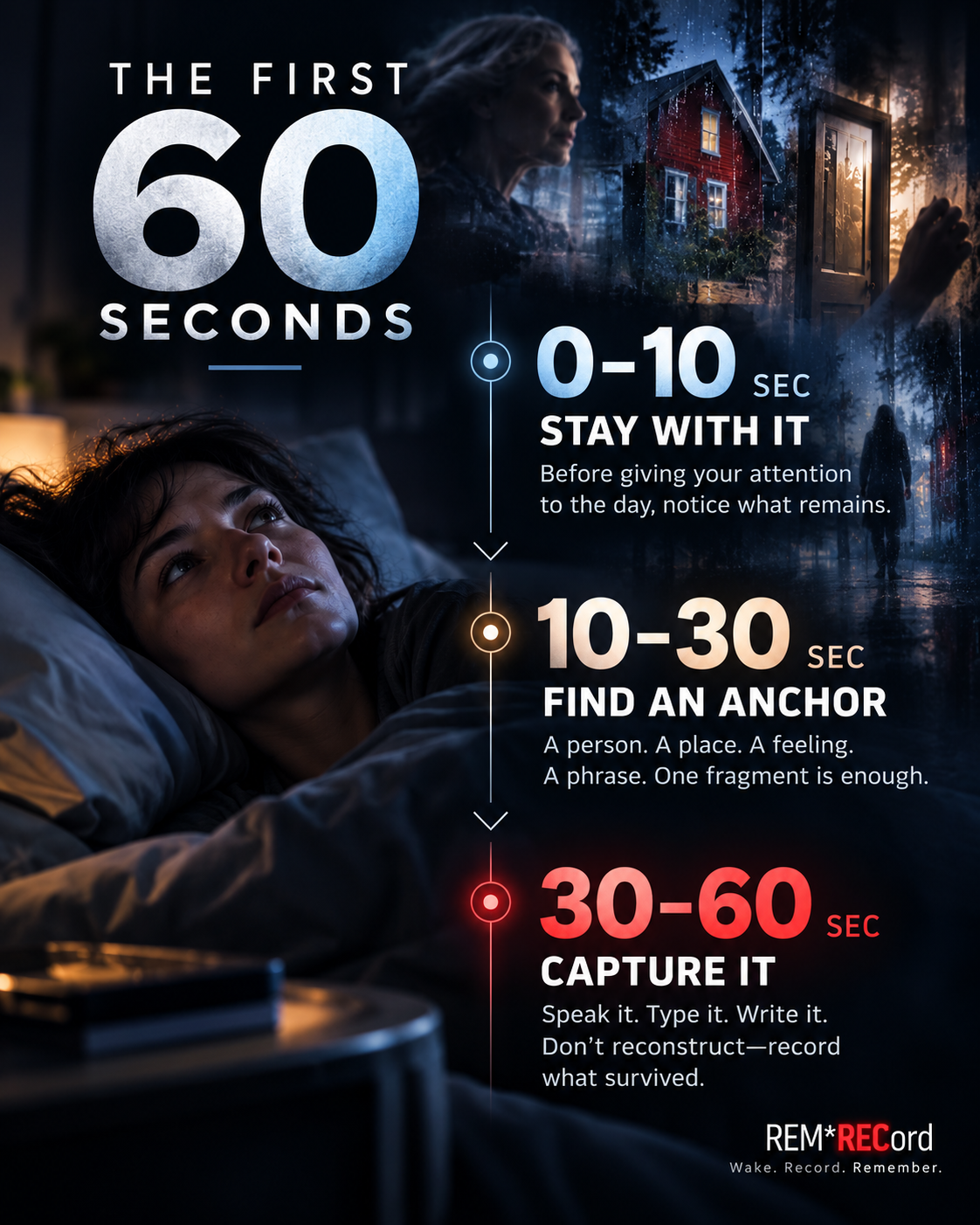
0–10 seconds: Stay with it
When you first wake up, resist the urge to immediately check notifications, email or the time.
Ask yourself:
What was happening just before I woke up?
Don't force an answer.
Notice whatever comes first.
It might be an image.
A person.
A place.
An emotion.
A sentence.
Even the simple feeling that something happened is a starting point.
10–30 seconds: Find one anchor
Now find the strongest piece that remains.
Maybe:
Your grandmother.
A red house.
Heavy rain.
Someone knocking on a door.
The feeling that you needed to get away.
Don't worry about putting these pieces in the correct order.
Your job isn't to write the story yet.
Your job is to catch an anchor before it slips away.
30–60 seconds: Capture it
Now record what you have.
Speak it.
Type it.
Write it.
If all you remember is:
“Grandmother. Red house. Rain. Someone was knocking. I felt scared.”
record exactly that.
Because five fragments captured are more useful than an entire dream you planned to write down later—but didn't.
Don't Reconstruct. Capture.

This is where REM*RECord takes a different approach to dream recall.
When people hear “keep a dream journal,” they may imagine waking up and writing several paragraphs describing a complete dream from beginning to end.
That can create unnecessary pressure.
Your dream does not need to be complete to be worth recording.
In fact, trying too hard to reconstruct missing portions can blur the line between what you actually remember and what you're filling in afterward.
Instead:
Don't reconstruct. Capture.
Record what is genuinely there.
If more comes back while you're talking or writing, add it.
If it doesn't, stop.
A fragment is still a record.
What Should You Record When You Barely Remember Anything?
When dream recall is weak, use these seven anchors:
WHO — Who was there?
WHERE — Where were you?
WHAT — What was happening?
FEELING — How did you feel?
OBJECT — Did anything stand out?
WORDS — Was anything said?
SENSORY DETAIL — Do you remember a color, sound, smell or physical sensation?
You don't have to answer all seven.
One is enough to begin.
Instead of staring at a blank dream journal trying to remember everything, ask:
What's the one thing I still know?
Start there.
The REM*RECord Method: Wake. Record. Remember.
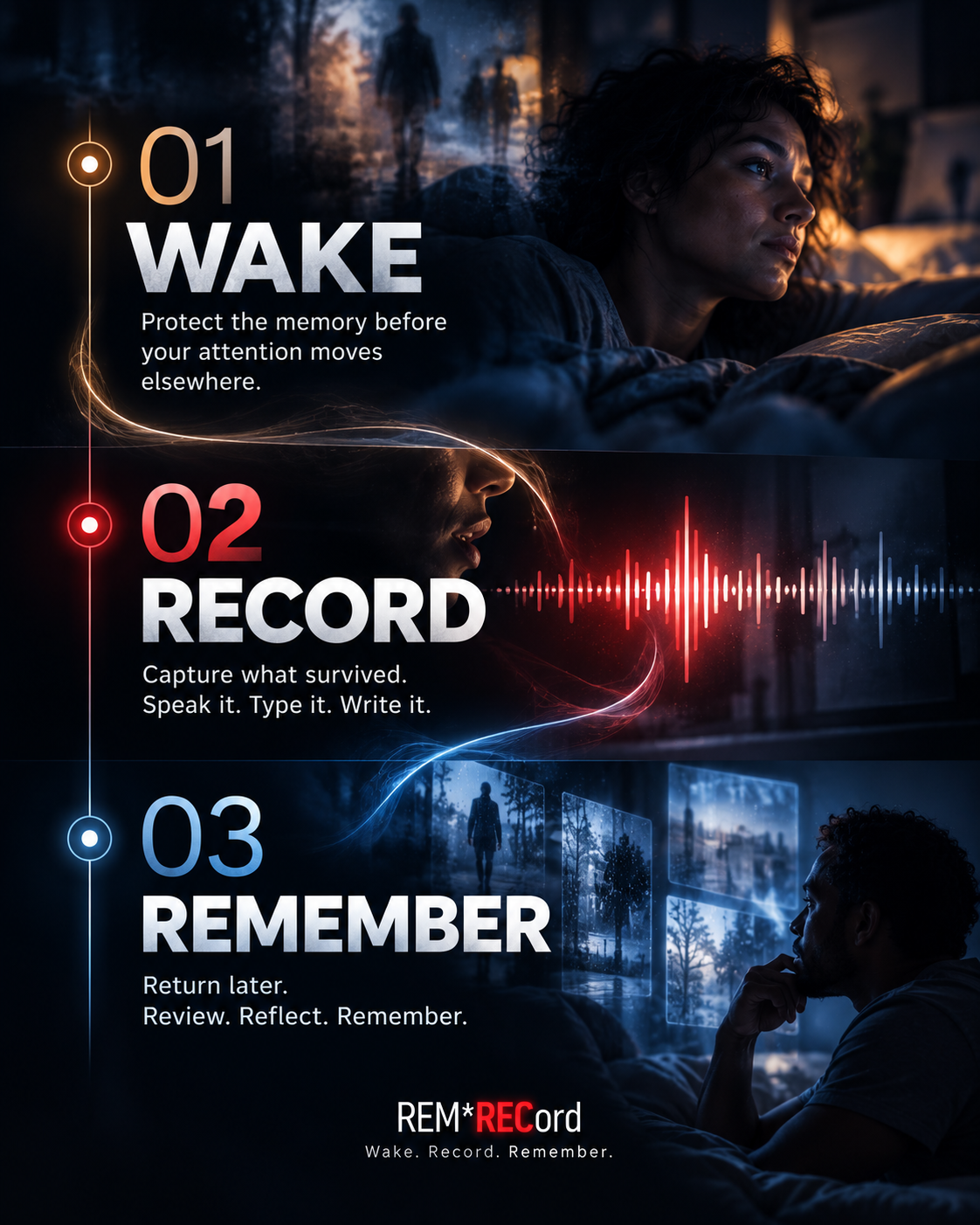
The entire process can be reduced to three actions.
WAKE
Before giving your attention to your phone, schedule or surroundings, briefly search for what remains of the dream.
Don't chase it.
Notice it.
RECORD
Capture the surviving pieces immediately.
You don't need perfect grammar.
You don't need chronological order.
You don't need an interpretation.
And you don't necessarily need to write.
A sleep psychologist interviewed by Cleveland Clinic notes that dream journaling can take different forms—including audio recordings of what you remember—and that the useful format is one you'll actually use consistently.
That's especially important when you're half asleep.
Speaking five remembered fragments may be considerably easier than turning on a light and composing five paragraphs.
REMEMBER
One dream is a memory.
A collection of dreams becomes a record.
Over time, keeping those records gives you something your memory alone can't easily provide: the ability to look back.
People can return.
Places can return.
Feelings can return.
Themes can return.
And instead of wondering, “Haven't I dreamed this before?” you have something to compare it with.
Wake. Record. Remember.
Can Keeping a Dream Journal Help You Remember More Dreams?
There is research suggesting that the way we track dreams matters.
A 2016 study published in Consciousness and Cognition investigated differences between people's retrospective estimates of dream recall and what they recorded while keeping logs. The findings indicated both that retrospective measures can underestimate dream recall and that keeping a logbook can enhance reported recall.
But the scientific picture deserves some caution.
Earlier research has also shown that the type and effort required by a dream log can affect reporting and motivation. A lengthy narrative journal may produce different results from a quick checklist, for example.
So we shouldn't turn dream journaling into a guarantee that you'll suddenly remember every dream.
A more useful question is:
What happens to your own dream recall when you consistently capture what you remember?
You can test that yourself.
Try the 7-Day Dream Recall Experiment

For the next seven mornings, try one simple experiment.
There is no required number of dreams to remember and no required length for an entry.
Every morning for seven days:
1. WAKE
Before scrolling through your phone, pause and ask:
What do I remember?
2. FIND ONE FRAGMENT
Person.
Place.
Feeling.
Object.
Action.
Words.
Anything.
3. RECORD IT
Capture whatever remains—even if it's only one sentence.
If you remember nothing except knowing that you dreamed, you can record that too.
4. DON'T FILL IN THE BLANKS
Only record what you actually remember.
5. REPEAT TOMORROW
Do it for seven mornings.
At the End of Seven Days, Look Back
Don't judge the experiment only by the number of dreams you recorded.
Ask:
Did I begin remembering dreams more often?
Did my entries become more detailed?
Did additional memories return while I was recording?
Did the same person appear more than once?
Did a location return?
Were certain emotions repeated?
Was there a morning when I remembered only a fragment—and another when I remembered an entire sequence?
There is no “correct” result.
The point is to stop relying on the question:
“Do I usually remember my dreams?”
and create an actual record of what happened.
Why Voice Recording Makes Sense for Dream Recall
Writing is powerful.
But immediately after waking isn't always the easiest time to write.
Your eyes may still be closed. The room may be dark. You may not want to sit up, turn on a light and start typing.
That's where voice-first dream recording has a practical advantage.
If you remember:
“I was at my childhood house. My father was there. Something was wrong with the sky...”
you can say it immediately.
Then keep talking if more returns.
The objective isn't to produce beautiful writing.
It's to reduce the distance between remembering a dream and preserving it.
That's the gap REM*RECord was designed to close.
Frequently Asked Questions About Remembering Dreams
Does everyone dream?
Dreaming and dream-like experiences have been reported following awakenings from multiple stages of sleep. Researchers continue to investigate how sleep stage, awakening conditions and individual differences influence whether those experiences are recalled.
Why do I forget my dreams when I wake up?
There isn't one explanation that applies to everyone. Research indicates dream recall is influenced by multiple factors, including characteristics of the sleeper and the circumstances surrounding awakening. Memory and attention after waking also matter to the process researchers are trying to understand.
Do dreams only happen during REM sleep?
No. REM sleep is strongly associated with dreaming, but dream experiences have also been reported after awakenings from non-REM sleep.
Can I train myself to remember dreams?
Dream-recording studies suggest that keeping a log can affect reported dream recall, although results depend partly on how recall is measured and how demanding the recording method is. Rather than expecting a guaranteed result, try consistently recording what you remember and observe whether your own recall changes.
What if I only remember one image?
Record it.
One image is more than zero.
Tomorrow it might be a person and a place. Another morning it might be an entire sequence.
Don't discard a dream because only part of it survived waking.
Should I write or voice-record my dreams?
Use the method you're most likely to use consistently. Writing, typing, drawing and audio recording can all serve as forms of dream journaling. Immediately after waking, some people may find speaking easier than writing.
Your Next Dream Doesn't Have to Disappear
Tomorrow morning, you may wake with an entire story.
Or you may have only:
A face.
A hallway.
A color.
A feeling.
That's enough.
Don't wait until you've reconstructed the dream.
Don't wait until you've had coffee.
Don't tell yourself you'll remember it later.
Capture what's left.
Try the 7-Day Dream Recall Experiment with REM*RECord and begin building a private record of the dreams that would otherwise be left to memory.
Wake. Record. Remember.
Research & Further Reading
Stucky, B. (2025). We are the Sensors of Consciousness! A Review and Analysis on How Awakenings During Sleep Influence Dream Recall. Nature and Science of Sleep. Review of 69 awakening studies conducted between 2000 and 2024.
Aspy, D. J. (2016). Is dream recall underestimated by retrospective measures and enhanced by keeping a logbook? An empirical investigation. Consciousness and Cognition, 42, 181–203.
Aspy, D. J., Delfabbro, P., & Proeve, M. (2015). Is dream recall underestimated by retrospective measures and enhanced by keeping a logbook? A review. Consciousness and Cognition, 33, 364–374.
Zadra, A., & Robert, G. (2012). Dream recall frequency: impact of prospective measures and motivational factors. Consciousness and Cognition, 21(4), 1695–1702.
Nemeth, G. (2023). The route to recall a dream: theoretical considerations and methodological implications. Psychological Research, 87(4), 964–987.
Cleveland Clinic (2024). Should You Be Keeping a Dream Journal? Includes guidance from sleep psychologist Alaina Tiani, PhD, on written, visual and audio approaches to dream journaling.